
From Product to Data: The Digital Product Passport (DPP) and the Future of Sustainable Products
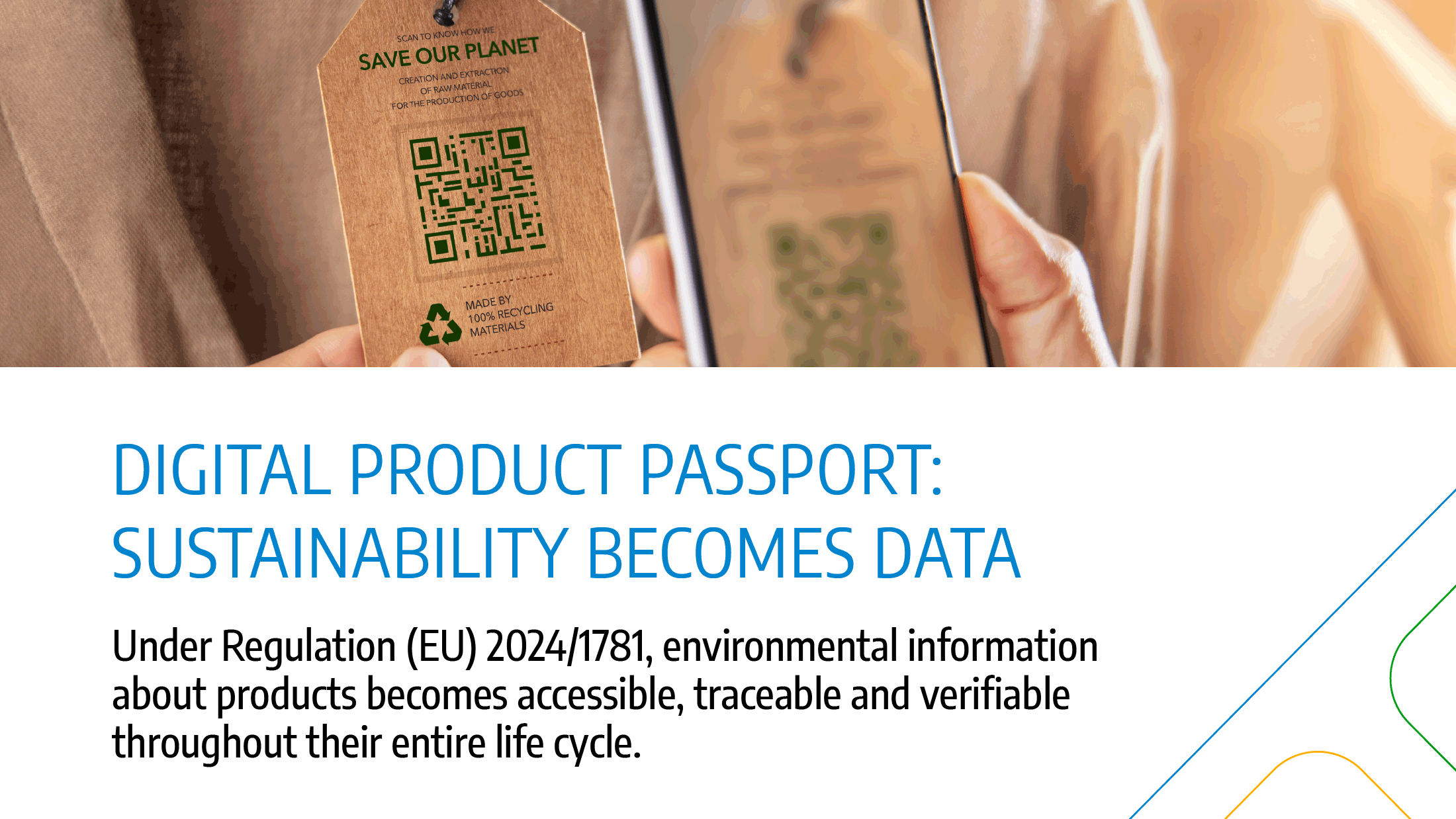
From product to data: with the Digital Product Passport (DPP), sustainability is entering a new phase based on accessible, traceable, and verifiable information throughout the entire product lifecycle.
This is one of the key innovations introduced by the Ecodesign for Sustainable Products Regulation (ESPR), Regulation (EU) 2024/1781, a cornerstone of the European strategy aimed at guiding the internal market towards an increasingly circular economy. The objective is to gradually move beyond the traditional linear model by promoting products designed to last longer and to be repaired, reused, and recycled. Manufacturers will therefore be required to provide relevant information throughout the product’s circular lifecycle.
In this context, the Digital Product Passport (DPP) is set to play a central role. It is a digital repository of product-related data designed to make sustainability, circularity, and regulatory compliance information available throughout the product’s lifecycle.
In practical terms, each product will be linked to a digital identifier, such as a QR code or another electronic carrier, through which consumers, public authorities, economic operators, repairers, and recyclers will be able to access information required under applicable legislation. Depending on the product category and the requirements established by delegated acts, the passport may include information on the origin of materials, recycled content, durability and repairability, environmental performance, reuse and recycling options, and the presence of substances relevant from an environmental perspective.
Greater transparency, certainly, but with one important clarification: the DPP is not a sustainability certification and does not automatically qualify a product as “sustainable.” Its value lies in making structured and verifiable environmental information available, facilitating its consultation and comparison. In this way, sustainability shifts from the realm of marketing claims to that of data, helping to combat greenwashing and support more informed purchasing decisions.
The introduction of the DPP will take place gradually, with different timelines depending on the product category. Businesses should therefore prepare in advance by organizing the collection, management, and updating of the required information while ensuring its accuracy, reliability, and availability throughout the supply chain.
The main implementation milestones can be summarized as follows:
- Batteries: From 18 February 2027, the first binding deadline will apply to the passport for industrial batteries, electric vehicle batteries, and batteries for light means of transport (LMT), such as e-bikes.
- Textiles and tires: Delegated acts are expected to be adopted during 2027, while the corresponding obligations are expected to become applicable between late 2028 and 2029.
- Furniture and electronics: Related obligations are expected to be introduced approximately between 2029 and 2030.
- Other product categories: The DPP will be progressively extended from 2030 onwards, according to the timeline established under the ESPR and its implementing acts.
The Digital Product Passport therefore represents much more than a new information tool. It is one of the mechanisms through which the principles of the circular economy can be translated into concrete, accessible, and usable data. If the European Green Deal sets the direction for Europe’s transition and the ESPR provides the regulatory framework for sustainable product design, the DPP serves as the information infrastructure that will make sustainability and circularity increasingly transparent, measurable, and verifiable throughout the entire product lifecycle.